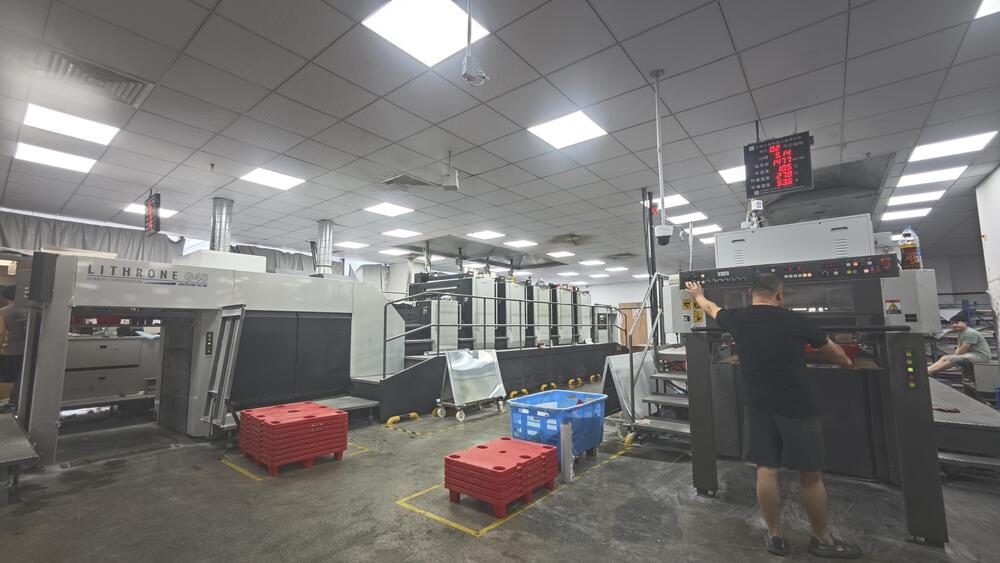
In YIMU’s printing workshop, notebook production is a hands-on process. An operator works at the KOMORI LITHRONE SX29 sheetfed offset press while a production supervisor follows the job on the floor. Nearby, printed sheets are brought under an inspection light so the team can look closely at the result before the work moves forward.
These scenes show an important part of custom notebook manufacturing: the press produces the sheets, but people monitor the run and judge what comes off it.
Operating the KOMORI LITHRONE SX29
The LITHRONE SX29 is a 29-inch sheetfed offset printing press made by KOMORI CORPORATION. In YIMU’s workshop, the operator’s attention stays on both the machine and the printed output. As sheets move through production, the operator observes the run, takes samples for review, and responds when the print needs adjustment.
For a custom notebook, the job might involve interior pages, printed cover sheets, or other paper components, depending on the design and production plan. The artwork and approved sample set the reference for what the team needs to reproduce. Fine rules, small text, illustrations, and brand colors each create different points to watch during printing.
The operator’s role is therefore more than starting the press. It includes checking that the work being produced still matches the job requirements as production continues.
Production Supervision on the Workshop Floor
A production supervisor checks the progress of the printing job while it is running. This gives the team a way to connect the approved specifications with what is happening at the press: the correct artwork version, paper, print appearance, and next production steps all need to stay aligned.
Supervision is especially useful when a notebook has several printed components. A cover and an interior may use different papers, colors, or finishing processes. Keeping track of each component helps prevent one part of the job from being treated as interchangeable with another.
When a sample needs closer attention, the supervisor and operator can review it together at the machine. That short pause in the production flow matters because a small printing issue is easier to address while the job is still on press.
Checking Printed Sheets Under Inspection Light
One of the clearest quality control scenes in the workshop is a worker holding a printed sheet under a light and examining it at close range. The light helps make visual differences easier to see. The worker can compare the sheet with the approved reference and look for issues such as uneven color, misaligned printed elements, weak fine lines, spots, or smudges.
For notebook interiors, even subtle changes matter. Lines that are too faint can be hard to use; lines that are too dark can compete with handwriting. On a printed cover, a shift in color or alignment may be immediately visible to a customer. Inspecting actual sheets during the run helps the team assess these details on the chosen paper, under real production conditions.
Visual inspection is one part of print quality control. The result still needs to be considered alongside the approved artwork, physical sample, and the requirements for later cutting, folding, binding, and finishing.
Why This Matters for Custom Notebook Buyers
Buyers often see a finished notebook, but the quality of its printed parts begins earlier. A well-designed file must translate into consistent physical sheets, and those sheets must remain suitable for the next manufacturing steps.
The scenes at YIMU’s press show how this is handled in practice: an operator runs the KOMORI LITHRONE SX29, production is supervised on the workshop floor, and workers inspect printed sheets under light. Together, these checks help the team spot visible issues while printing is underway and keep the output aligned with the approved project requirements.
If you are developing a notebook with custom interiors or a printed cover, it helps to approve the paper, color expectations, and physical sample before bulk production. Our custom notebook sample checklist explains what to review. You can also explore our hardcover notebook products and OEM and ODM notebook manufacturing services.
Frequently Asked Questions
What type of press is the KOMORI LITHRONE SX29?
It is a 29-inch sheetfed offset printing press. The printing approach for a specific notebook component depends on its artwork, paper, quantity, and production plan.
Why inspect printed sheets during production?
Reviewing sheets while a job is running helps workers identify visible differences from the approved result and decide whether the press output needs attention before more sheets are produced.
What can a worker check under an inspection light?
The worker can look closely at color appearance, registration, fine details, spots, and smudges on the actual printed paper. The approved sample and job requirements provide the comparison point.
Does the press alone guarantee print quality?
No single machine feature replaces an approved sample or human review. The operator, supervisor, and inspection process all contribute to keeping the printed output aligned with the project specifications.
Plan Your Notebook Printing with YIMU
Tell us about your notebook size, paper, interior layout, cover design, quantity, and target market. YIMU can review the printing requirements as part of the complete custom notebook project.