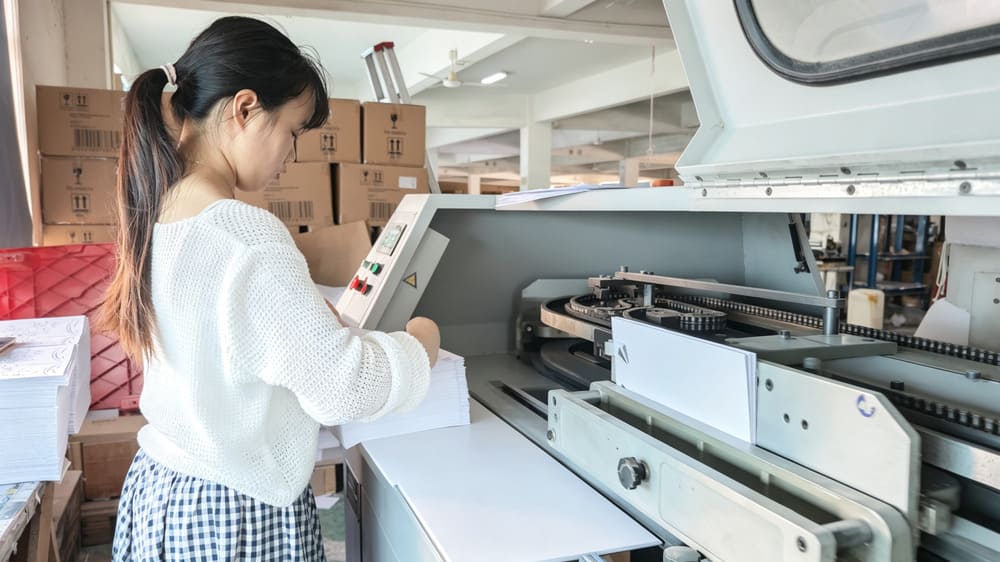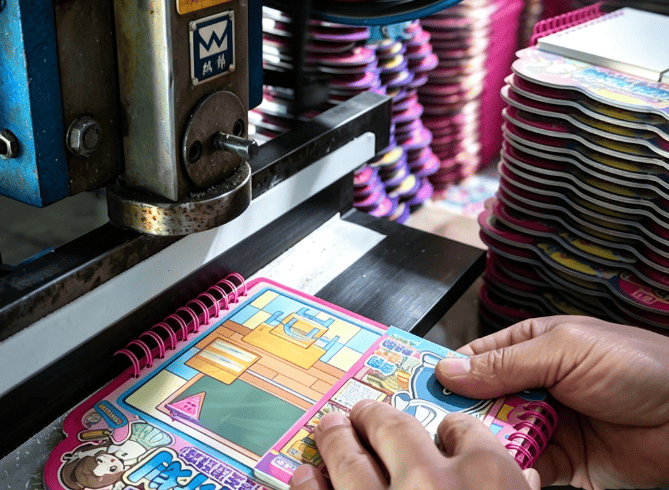
A wire-bound notebook depends on a close match between the punched holes, page stack, cover, and metal binding element. If one part is out of position, the finished notebook may have stiff pages, an uneven spine, exposed wire ends, or a binding that opens under handling.
In YIMU’s wire-binding workshop, a trained operator uses a Shuangwei tabletop press fitted for the required binding operation. The press applies a controlled closing or forming action to the metal binding wire after the notebook components have been punched, collated, and placed in the correct sequence.
The machine supplies repeatable pressure. The operator and process checks determine whether the notebook is correctly positioned, whether the tooling suits the binding element, and whether the completed product turns smoothly and matches the approved sample.
What Is a Notebook Wire Closing Machine?
A notebook wire closing machine brings an open metal binding element to its finished shape around a stack of punched pages and covers. In double-loop wire binding, often called Wire-O binding, the open wire is inserted through a row of matched holes and then closed with a pressing or closing tool.
YIMU’s Shuangwei tabletop press is used with job-specific tooling for this production step. The exact press setup depends on the machine, die or closing fixture, binding width, and notebook specification.
This operation is only one part of the complete wire-binding process. Before a notebook reaches the closing station, the production plan may include:
- cutting covers and inner pages to the required dimensions;
- punching holes with the specified pattern and pitch;
- checking the page and component sequence;
- selecting a binding element that suits the book thickness;
- cutting the wire to the required length;
- inserting the open wire through the aligned holes; and
- positioning the assembly in the closing tool.
After closing, the notebook is inspected for wire shape, page movement, spine alignment, wire ends, and overall appearance.
The Role of Wire Closing in Notebook Production
Wire closing converts separate components into a functional notebook. It secures the cover and inner pages while allowing each punched leaf to rotate around the binding.
This construction is often selected for planners, journals, workbooks, presentation books, training materials, and other products that need to open widely or fold back on themselves. The visible metal binding also becomes part of the product’s design.
The closing stage affects several customer-facing details:
- how easily the pages turn;
- whether the covers align with the interior;
- whether the notebook sits evenly when closed;
- whether the wire maintains a consistent shape;
- whether the join and cut ends are safely positioned; and
- whether pages remain retained during normal use.
A good result cannot be created by pressing alone. Hole punching, collation, book thickness, wire selection, tooling, alignment, and inspection must all work together.
Wire-O, Spiral Coil, and Other Ring Bindings
The term “spiral notebook” is often used broadly, but different binding systems are not interchangeable.
Wire-O or double-loop wire uses paired metal loops that start in an open shape and are pressed closed around the book. A continuous spiral coil is inserted by rotating it through a series of holes and normally requires its ends to be secured. Plastic comb binding uses a different plastic element and hole pattern.
Each system has its own punching pitch, hole shape, binding element, and closing method. YIMU confirms the intended construction before production so the artwork, page stack, hole pattern, and binding materials remain compatible.
For this article, “wire closing” refers to the operation shown in the supplied brief using the Shuangwei tabletop press. The published media should make the binding type visually clear.
How YIMU Prepares a Wire-Binding Job
1. Confirming the approved product specification
The team checks the order requirements before setup. Relevant details may include the finished size, binding edge, page count, paper, covers, dividers, hole pattern, binding color, wire size, binding length, quantity, and packaging instructions.
Similar-looking interiors, language versions, dated planners, and cover designs remain identified throughout production to reduce the risk of mixed components.
2. Checking punched components
The holes in the front cover, inner pages, dividers, pockets, and back cover need to follow the same binding pattern. The team checks for displaced holes, incomplete punching, torn edges, retained paper chips, or components loaded in the wrong orientation.
Hole position affects more than appearance. Holes that sit too close to the paper edge may tear more easily, while holes placed too far inward can reduce the usable page area or make turning feel tight.
3. Collating the notebook
The punched components are placed in the correct sequence before wire insertion. The page count, orientation, cover order, divider position, and any accessory sheets are checked against the job requirement.
A binding machine cannot correct a missing page or reversed cover after the wire has been closed. Early sequence control reduces rework and prevents good materials from being damaged during disassembly.
4. Selecting and preparing the binding element
The binding element must suit the punched pattern, binding length, and thickness of the assembled notebook. A wire that is too small can compress the pages and restrict turning. A wire that is too large may feel loose, produce an oversized spine, or allow excessive movement.
Wire color and finish are also checked against the approved sample. Cut length and end condition need to suit the product and the chosen closing method.
5. Setting the press and tooling
The Shuangwei tabletop press is prepared according to its operating instructions and the job-specific tooling procedure. The closing position and stroke must suit the binding element without crushing the paper or overforming the wire.
Setup and die work are restricted to trained personnel. The operator uses approved samples or setup pieces to confirm the result before continuing with the production batch.
6. Closing and inspecting initial samples
The assembled notebook is positioned in the designated closing fixture, and the press forms the wire to the required shape. The first completed pieces are checked for closure, alignment, page turning, wire ends, and cosmetic condition.
If the result does not match the approved reference, the setup, component thickness, wire, positioning, or tooling is reviewed before mass production continues.
Safe Working Practices Around a Tabletop Press
A tabletop pressure machine contains a moving ram and tooling that create a point-of-operation crushing hazard. The small size of the machine does not make the closing area safe for hands.
General safety principles include:
- allowing only trained and authorized personnel to operate, set up, clean, or maintain the press;
- completing the required pre-start checks;
- confirming that point-of-operation guards and other protective devices are installed and functioning;
- using the designated fixture, holder, feed aid, or handling method for the notebook and wire;
- keeping fingers and other body parts out of the die or closing area during the press stroke;
- never bypassing a guard, interlock, control, or single-stroke protection;
- protecting any foot control against unintended activation, if the installed machine uses one;
- stopping the machine before correcting a displaced notebook or binding element;
- disconnecting and isolating power before die adjustment, clearing trapped material, cleaning, or maintenance as required by the procedure; and
- reporting abnormal movement, repeated cycling, damaged tooling, unusual noise, or a defective safeguard.
The exact controls and safeguards must be confirmed for YIMU’s specific Shuangwei press. These points do not replace the machine manual, risk assessment, training, or workplace procedure. Foot control alone does not keep an operator’s hands away from a press closing point.
How YIMU Checks Wire-Bound Notebook Quality
Hole alignment
The holes should form a consistent line along the binding edge. Covers, pages, and dividers are compared for offset, skew, tears, and incomplete punching. Paper chips left inside the holes are removed before they interfere with wire insertion or page movement.
Component sequence and orientation
The operator or quality team checks that the front cover, inner pages, special sections, and back cover appear in the approved order and direction. Dated pages, tabs, and printed headers make sequence errors especially visible.
Wire size and fit
The closed wire must leave enough room for pages to turn without creating excessive looseness. The team evaluates the actual assembled notebook rather than choosing the binding only from page count, since paper and cover thickness also affect the book block.
Closure shape
The metal binding element is checked along its full length. The closure should be consistent and should not show uncontrolled gaps, flattening, twisting, or distortion. The desired shape depends on the approved binding system and tooling.
Binding alignment
The wire should run parallel to the notebook edge. A binding that rises, dips, or shifts along the spine may indicate incorrect insertion, component alignment, wire length, positioning, or press setup.
Cut ends and joining area
The ends of the wire are checked for sharp projections, unwanted gaps, or positions that can catch on packaging or scratch the user. The joining area should be located and finished according to the product specification.
Page-turning test
The sample is opened from the front, middle, and back. Pages should move around the binding without sticking, tearing at the holes, or colliding with a closure defect. The covers are also folded back if that movement is part of the intended use.
Notebook shape and appearance
The completed notebook is checked when open, closed, and viewed along the spine. Covers and inner pages should align as specified. The binding should not crush the edge, mark the cover, or create an unintended curve in the page stack.
In-process checks
The approved first piece establishes the setup reference, but inspection continues during production. Tooling position, wire supply, component thickness, and operator loading can vary during a run. Periodic checks help identify changes before more notebooks reach packaging.
Why Punching Quality Matters Before Wire Closing
The closing press can only work with the holes it receives. If the hole pitch does not match the binding element, the wire will not pass cleanly through the book. If cover and page holes are offset, the finished notebook may turn poorly or sit unevenly.
Punching also needs to account for the full component set. A laminated cover may behave differently from an uncoated interior page. Dividers, pockets, boards, or specialty inserts can increase thickness and may need their own setup or production sequence.
YIMU checks the assembled result rather than judging the punched components separately. This connects punching quality with wire fit, page movement, and finished appearance.
Why Wire Binding Matters to Custom Notebook Buyers
Wire-bound construction gives buyers several design options. A notebook can open wide, fold back for compact use, and display a visible metal spine that coordinates with the cover design.
The best result comes from selecting the binding at the beginning of product development. Page count, paper, cover thickness, tabs, pockets, binding edge, hole pattern, and artwork margins should be planned together.
When reviewing a sample, buyers should:
- turn pages from the front, middle, and back;
- fold the covers back if the design is intended to do so;
- inspect holes for tearing or retained paper chips;
- look along the full binding for an even closure;
- check the wire ends and joining area;
- confirm cover and page alignment;
- compare the binding color and finish with the approved choice; and
- test the notebook in its expected writing or display position.
Our custom notebook sample checklist explains what to approve before mass production. You can browse YIMU’s spiral notebook products and learn more about our OEM and ODM notebook manufacturing services.
Frequently Asked Questions
What does YIMU use the Shuangwei tabletop press for?
Based on the supplied production brief, YIMU uses the press with suitable tooling to close or form the metal binding element on wire-bound notebooks. The exact model and installed tooling should be confirmed from the workshop equipment before publication.
Is Wire-O binding the same as spiral coil binding?
No. Wire-O binding uses a double-loop metal element that is pressed closed. Continuous spiral binding uses one coil that rotates through the punched holes. The hole patterns, insertion methods, and finishing operations differ.
How is the correct wire size selected?
The wire needs to match the hole pattern and assembled book thickness while leaving enough room for pages to turn. Paper, covers, dividers, pockets, and other components all contribute to the required capacity.
Why might pages feel tight after binding?
Possible causes include an undersized binding element, overclosing, mismatched hole pitch, displaced holes, excessive book thickness, damaged holes, or an incorrectly positioned joining area. The complete sample needs to be reviewed.
What defects are checked after wire closing?
Typical checks include uneven closure, distorted loops, excessive gaps, crushed edges, sharp wire ends, misaligned covers, torn holes, poor page movement, and an incorrect component sequence.
Can a Wire-O notebook fold back on itself?
Wire-bound notebooks are commonly designed to fold back, but the result depends on the binding size, closure, page and cover thickness, hole pattern, and product structure. This movement should be tested on the approved physical sample.
Is this article an operating guide for a tabletop press?
No. A tabletop press can cause serious crushing injuries at the die or closing point. Only trained and authorized personnel should operate, adjust, clean, or maintain the machine according to its manual and YIMU’s safety procedure.
Plan a Wire-Bound Notebook with YIMU
Share your notebook size, page count, paper, cover material, dividers, pockets, binding edge, preferred wire color, quantity, packaging needs, and target market. YIMU can review how these choices fit into cutting, punching, collating, wire closing, inspection, and packing.