A hardcover notebook begins with more than a printed cover design. The covering material must be joined to rigid boards in the correct position, wrapped neatly around the edges, and prepared to fit the book block. A small difference in board spacing or cover alignment can become highly visible after the notebook is assembled.
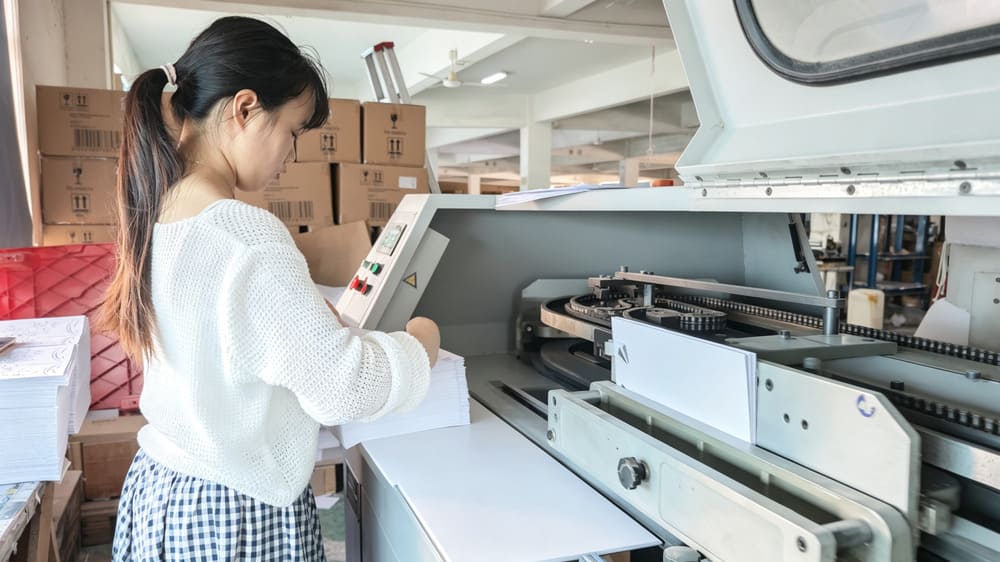
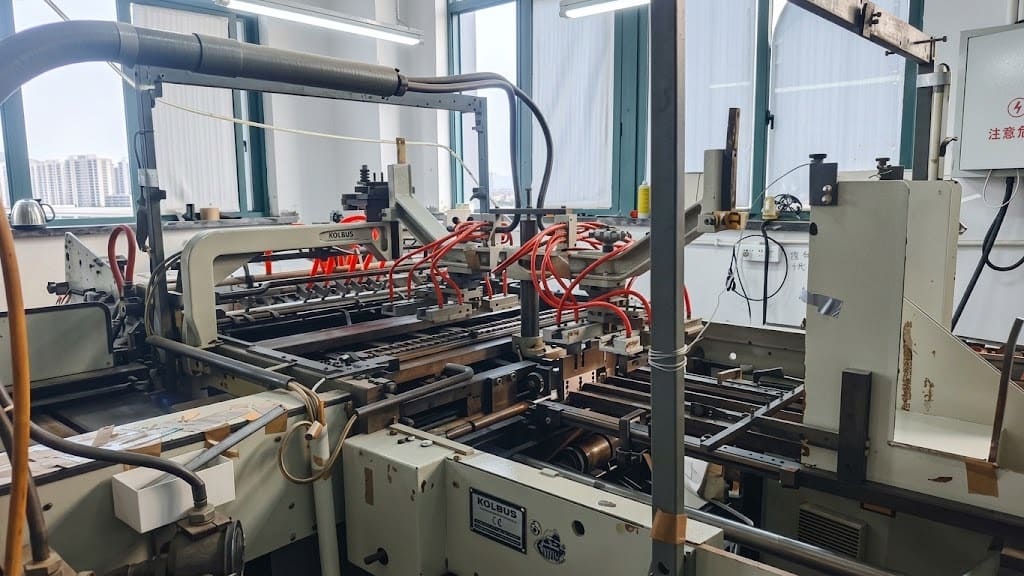
In YIMU’s hardcover workshop, a trained operator monitors a KOLBUS case-making machine as cover materials and board components move through production. The machine supports repeatable gluing, positioning, turning-in, and pressing operations, depending on its installed configuration. The operator checks materials, observes the process, and reviews completed cases before they move to the next stage.
The equipment is one part of the quality system. Artwork preparation, board cutting, material conditioning, adhesive control, machine setup, inspection, and later casing-in all influence the finished hardcover notebook.
What Is a Case-Making Machine?
A case-making machine produces the rigid outer case used for a hardcover notebook, journal, planner, or book. The case is normally built from a covering material, two cover boards, and a spine component or defined spine space.
Depending on the product design, the covering material may be:
- printed and laminated paper;
- cloth or bookbinding fabric;
- PU or another synthetic covering material;
- specialty paper; or
- another material approved for the case-making process.
The main case-making stages can include adhesive application to the covering material, placement of the boards and spine component, corner preparation, turning the covering material over the board edges, and pressing or rubbing down the assembled case.
The completed case is not yet a finished notebook. It later needs to be combined with the prepared book block in the casing-in process and may undergo pressing, joint setting, cleaning, and final inspection.
The Role of KOLBUS Equipment in Hardcover Production
KOLBUS manufactures industrial equipment for hardcover case production. At YIMU, the KOLBUS case maker helps organize repeated cover-making operations into a controlled production flow.
The machine must bring several components together accurately:
- the covering material;
- the front board;
- the back board;
- the spine board or spine strip, when the design uses one;
- the adhesive layer; and
- the turned-in edges and corners.
These parts must form a case that is square, correctly spaced, properly bonded, and compatible with the approved book block. The visual design also needs to remain centered after the material is wrapped around the boards.
KOLBUS equipment provides the mechanical platform for case production, but the brand name alone does not determine the result. The operator, materials, job data, tooling, adhesive condition, and inspection plan remain important.
Case Making and Casing-In Are Different Processes
Case making creates the empty rigid cover. Casing-in joins that case to the book block, usually through the endpapers and the specified spine or hinge structure.
Keeping the two stages separate is useful when evaluating quality. A case may be well made but unsuitable for a particular book block because the spine width, joint spacing, or board dimensions are wrong. A correctly sized case may also be damaged by poor casing-in alignment or pressing.
YIMU therefore checks both the case itself and its relationship with the sample book block. The final notebook depends on the fit between these components, not on either one in isolation.
How YIMU Prepares a Case-Making Job
1. Confirming the approved specification
The production team checks the requirements for the notebook before setup. Relevant information may include the finished size, board dimensions, board thickness, spine construction, joint width, covering material, wrap allowance, artwork position, adhesive requirement, corner style, quantity, and next production stage.
The latest artwork and physical sample must stay associated with the correct order. Similar cover versions, foil colors, languages, planner years, or customer logos should remain clearly identified.
2. Checking covering materials
The covering material is checked for the correct design, direction, size, print appearance, surface finish, and condition. Creases, scratches, contamination, edge damage, or inconsistent curl can affect feeding and the appearance of the completed case.
Printed covers also need enough allowance for wrapping. Important text, borders, logos, and centered artwork must be planned with the board position, spine area, joint, turn-ins, and manufacturing variation in mind.
3. Checking boards and spine components
The front and back boards are checked for dimensions, thickness, squareness, surface condition, and correct quantity. The spine component must suit the approved case and book-block structure.
Board grain direction, moisture, storage, and flatness can influence warping. Mixed board thicknesses or damaged edges can create visible steps, uneven corners, or an unstable case.
4. Preparing adhesive and machine settings
The adhesive system is prepared according to the material specification, supplier guidance, and machine procedure. Its application condition must suit both the covering material and the board.
Machine settings are prepared for the cover size, board positions, spine arrangement, wrap allowance, turning-in, pressing, and delivery. The exact setup depends on YIMU’s KOLBUS model and installed configuration.
5. Producing and checking setup cases
Initial cases are checked before the full batch continues. The team reviews dimensions, board spacing, spine position, printed artwork, wrap, corners, adhesion, flatness, and overall appearance.
A setup case may also be compared with the approved book block to confirm the intended fit. If the result does not match the job, the materials or setup are reviewed before continued production.
Adhesive Application and Material Bonding
The adhesive layer connects the covering material to the board. It needs to be suitable for the selected materials and applied in a controlled condition.
Uneven or incomplete application can lead to lifting, bubbles, loose edges, or local areas that do not lie flat. Excess adhesive can squeeze out, mark the covering material, increase moisture, or contribute to distortion. The best application is not simply the thickest layer.
Different materials absorb and release moisture differently. Paper, cloth, laminated sheets, PU materials, and rigid board can respond differently to the same adhesive. Production trials and an approved physical sample help the team confirm the combination before bulk manufacturing.
Clean handling also matters. Adhesive on the printed face, foil, lamination, cloth, or machine contact surfaces can create marks that remain visible on a premium hardcover.
Board Position, Spine Space, and Joints
The front and back boards must be positioned squarely on the covering material. Their relationship to the spine component determines the case width and the joint areas that allow the cover to open around the book block.
Incorrect spacing can cause several problems:
- a spine that does not match the book-block thickness;
- front and back boards that sit unevenly;
- joints that are too tight or too loose;
- cover artwork that shifts away from its intended position;
- poor opening behavior after casing-in; or
- exposed or stressed covering material near the hinges.
The correct spacing is based on the approved construction, not a universal number. Board thickness, book-block shape, spine design, endpapers, lining, and pressing method all affect the final fit.
Turn-Ins and Corner Quality
After the boards are placed, the covering material is wrapped over the board edges. These wrapped areas are called turn-ins. The corners require controlled cutting, folding, and compression so they cover the board without excessive bulk or exposed board.
YIMU checks:
- turn-in width and consistency;
- adhesion along all four edges;
- corner coverage;
- corner symmetry;
- folds or pleats;
- exposed board fibers;
- excess material buildup; and
- marks or damage on the cover face.
The acceptable corner construction depends on the material and approved design. A thick cloth, laminated paper, and PU covering do not fold in exactly the same way.
Safe Working Practices Around a Case-Making Machine
An industrial case maker can contain feeders, rollers, grippers, glue application units, board-positioning mechanisms, turn-in stations, pressing parts, conveyors, and heated components. These can create trapping, crushing, drawing-in, burn, and entanglement hazards.
General safety principles include:
- allowing only trained and authorized personnel to operate, adjust, clean, or service the machine;
- completing the required pre-start inspection;
- confirming that fixed guards, interlocked guards, tunnel guards, and emergency controls are in place and functioning;
- keeping hands, hair, clothing, jewelry, tools, and loose material away from rollers, belts, grippers, pressing areas, and other moving parts;
- using the specified controls and slow-movement procedure during approved setup work;
- never bypassing a guard, interlock, sensor, or other safety device;
- stopping the machine and following the approved procedure before clearing a misfeed or trapped case;
- isolating hazardous energy before cleaning, roller access, glue-system work, adjustment, or maintenance as required by the machine procedure;
- keeping clear of hot adhesive or heated crease-forming components if the installed system uses them; and
- reporting leaks, damaged guards, abnormal noise, repeated feeding faults, or unexpected movement.
The exact procedure depends on the KOLBUS model, installed options, adhesive system, and YIMU’s risk assessment. This overview does not replace the equipment manual or operator training.
How YIMU Checks Hardcover Case Quality
Dimensions and squareness
The overall case, front board, back board, spine, and relevant gaps are checked against the approved requirement. Diagonal or reference measurements can help identify a case that is not square.
Artwork and cover alignment
Printed graphics, borders, logos, foil, and other design elements are compared with the approved sample. The team considers how the artwork sits on the front, back, spine, and joints after wrapping, not only where it appeared on the flat covering sheet.
Board and spine position
The boards and spine component are checked for parallel alignment and correct spacing. A shifted component can affect cover symmetry and the fit of the later book block.
Adhesion and surface condition
The covering material should lie against the board without unintended bubbles, lifting, wrinkles, glue marks, dents, or trapped debris. The inspection method must suit the material, since textured cloth and smooth laminated paper have different normal appearances.
Turn-ins and corners
All edges and corners are reviewed for consistent wrapping and secure adhesion. The team looks for exposed board, open corners, bulky folds, uneven overlap, loose fibers, and damaged surface finishes.
Flatness and warping
Cases are checked on a suitable flat surface after the adhesive has reached the condition required by the process. Moisture imbalance, material tension, storage, board condition, or stacking can cause a case to bow or twist.
Fit with the book block
A case that passes its individual checks still needs to suit the book block. Sample assembly helps confirm spine width, board projection, joint movement, cover alignment, and the relationship between the case and endpapers.
In-process inspection
The approved first case provides the setup reference, but checks continue throughout the run. Board supply, covering material, adhesive condition, feeding, positioning, and fold quality may change. Periodic inspection helps identify variation before more cases reach casing-in.
Controlling Warping in Hardcover Cases
Warping is influenced by the balance of materials and moisture across the case. Adhesive introduces moisture or heat, while paper, cloth, board, lamination, and printed layers respond at different rates.
YIMU manages this through material selection, storage, adhesive control, pressing, stacking, conditioning, and inspection appropriate to the product. A case should not be judged at an arbitrary moment if the adhesive has not yet reached the handling condition defined for the process.
The final construction also matters. Endpapers and casing-in adhesive add another material layer to the inside of the cover. This is one reason the finished notebook sample remains the most meaningful reference for buyer approval.
Why Case Making Matters to Custom Notebook Buyers
The hardcover case is the first part of a notebook that customers see and touch. Its alignment, corners, surface, rigidity, spine, and opening behavior shape the impression of the whole product.
Buyers should examine more than the front artwork. A useful sample review includes:
- front, back, and spine alignment;
- board projection around the book block;
- joint width and opening movement;
- turn-in consistency;
- corner coverage and symmetry;
- visible bubbles, wrinkles, dents, or glue marks;
- flatness when the notebook is closed;
- endpaper adhesion; and
- fit between the case and the book block.
Our custom notebook sample checklist explains what to approve before mass production. You can browse YIMU’s hardcover notebook products and learn more about our OEM and ODM notebook manufacturing services.
Frequently Asked Questions
What does a KOLBUS case-making machine do?
It produces rigid cases from covering material, front and back boards, and a spine component or defined spine area. Depending on the model and configuration, it can support gluing, board placement, corner preparation, turning-in, pressing, and delivery.
Is case making the same as attaching the cover to the notebook?
No. Case making produces the empty hardcover. Casing-in is the later process that joins the prepared book block to that case, usually through the endpapers and specified spine structure.
Which materials can be used for a hardcover case?
Common choices include printed paper, laminated paper, cloth, bookbinding fabric, PU, and specialty paper. The material must be tested with the selected board, adhesive, printing or finishing, and case construction.
What causes bubbles or wrinkles on a hardcover?
Possible causes include uneven adhesive, contamination, unsuitable material combinations, incorrect pressure, feeding variation, trapped air, poor surface condition, or material movement before the bond has stabilized.
Why is the gap beside the spine important?
The joint areas help the front and back covers open around the spine and book block. Incorrect spacing can affect movement, appearance, artwork position, and case fit.
Why can a hardcover case warp?
Board condition, grain direction, moisture, adhesive, heat, covering material, lamination, pressing, stacking, storage, and the balance between the outside and inside layers can all influence flatness.
Is this article an operating guide for a KOLBUS case maker?
No. Case-making machines contain powered feeders, rollers, grippers, pressing parts, and adhesive systems. Only trained and authorized personnel should operate or service the equipment according to the exact machine manual and YIMU’s procedures.
Plan a Custom Hardcover Notebook with YIMU
Share your notebook size, page count, book-block structure, board thickness, spine design, cover material, artwork, surface finish, quantity, packaging needs, and target market. YIMU can review how these choices fit into printing, case making, casing-in, pressing, and final inspection.