Choosing a custom notebook size affects much more than how the product looks on a shelf. It determines how much customers can write, where they can carry it, how the inner pages should be designed, and how the finished order will be packed.
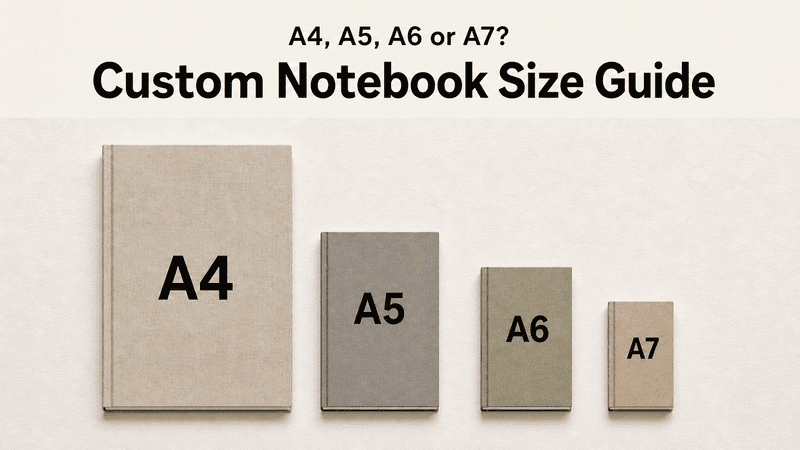
As a starting point, choose A4 for generous writing space, A5 for a balance of space and portability, A6 for compact everyday notes, and A7 for short reminders and mini notebooks.
The right choice depends on the intended use, not simply on which format is largest or smallest. This custom notebook size guide compares the four formats and explains what brands, importers and wholesale buyers should confirm before sampling or production.
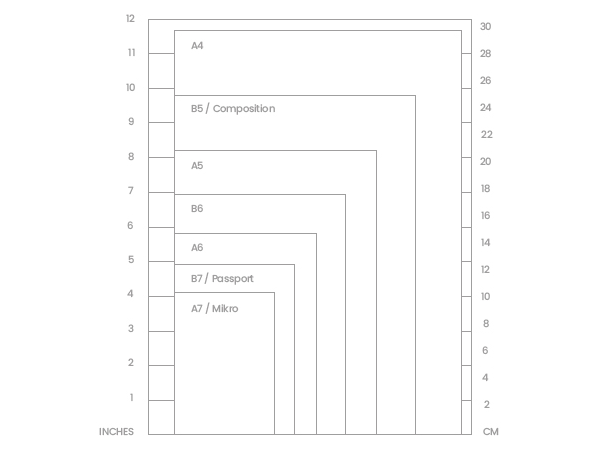
A4, A5, A6 and A7 Notebook Size Chart
The following dimensions refer to standard A-series trimmed paper sizes in portrait orientation. Inches are converted from millimeters and rounded to two decimal places.
| Format | Width × Height in mm | Width × Height in cm | Width × Height in Inches | Suggested Starting Use |
|---|---|---|---|---|
| A4 | 210 × 297 mm | 21 × 29.7 cm | 8.27 × 11.69 in | Detailed notes, training workbooks, desk-based planning |
| A5 | 148 × 210 mm | 14.8 × 21 cm | 5.83 × 8.27 in | Journals, meeting notebooks, everyday planners |
| A6 | 105 × 148 mm | 10.5 × 14.8 cm | 4.13 × 5.83 in | Compact notes, travel lists, small journals |
| A7 | 74 × 105 mm | 7.4 × 10.5 cm | 2.91 × 4.13 in | Brief reminders, mini notebooks, compact gift sets |
The paper dimensions are listed in Adobe’s A-series size chart. ISO 216 defines A-series trimmed paper sizes; these labels do not, by themselves, specify a finished notebook’s cover or overall dimensions.
How the A-Series Sizes Relate
The larger the number, the smaller the paper. Each step from A4 to A5, A5 to A6, or A6 to A7 approximately halves the page area while maintaining the same basic proportions. Standard millimeter dimensions involve rounding.
This means an A4 page offers approximately twice the area of A5 and eight times the area of A7. It does not mean an A4 notebook has twice the page count, or that its production cost will be twice as high.
A4 Notebooks: More Room for Detailed Work
An A4 notebook has a standard interior page size of 210 × 297 mm.
Choose this format when customers need space for diagrams, tables, long notes, worksheets or several types of information on one page. It is a practical option to evaluate for training materials, classroom activities, project records and desk-based planning.
The extra space can make larger handwriting and structured exercises more comfortable. A page can include instructions and a response area without making either too small.
The trade-off is portability. A4 needs more room in a bag, on a desk and in retail packaging. With the same paper, leaf count and comparable construction, it also requires more paper than a smaller format.
Before choosing A4: Check the space where the notebook will actually be used. A large notebook may be convenient on a desk but awkward on a small event table or during standing note-taking.
A5 Notebooks: A Balanced Starting Point
An A5 notebook has a standard interior page size of 148 × 210 mm.
A5 is a useful starting point for a general-purpose notebook because it provides room for sustained writing without the footprint of A4. Brands can consider it for retail journals, meeting notebooks, guided journals, employee notebooks and planners.
It can accommodate several interior approaches, including ruled pages, dot grids, simple weekly layouts and meeting-note templates. The layout still needs to be designed at actual size; a detailed planner can become crowded even in A5.
For a first private label collection, an A5 sample can serve as a reference against which to compare a larger or smaller option. This is a practical development approach, not a guarantee that A5 will sell best in every market.
Before choosing A5: Test one complete page of the intended content. If the user needs a spacious timetable, many task fields or large diagrams, compare it with A4 before finalizing the format.
A6 Notebooks: Compact Without Becoming a Miniature
An A6 notebook has a standard interior page size of 105 × 148 mm.
A6 is worth considering when the notebook will be carried frequently and used for shorter entries. Examples include travel notes, shopping lists, quick work notes, simple habit logs and compact journals.
The smaller page encourages simpler layouts. A short title field and an open writing area may work better than a multi-column worksheet. Keep branding restrained so the logo, headers and decorative borders do not consume too much space.
Do not describe every A6 notebook as pocket-fitting without testing the finished product. A thick hardcover, protruding wire, pen loop or closure can change its overall footprint considerably.
Before choosing A6: Try writing with the actual notebook in hand and on a surface. Confirm that the binding margin leaves enough usable width and that the finished thickness suits the carrying scenario.
A7 Notebooks: For Quick Notes and Small Spaces
An A7 notebook has a standard interior page size of 74 × 105 mm.
A7 suits brief entries rather than long-form writing. It can work for reminders, short lists, compact promotional notebooks or a small component in a coordinated stationery set.
Design restraint is especially important at this size. A full weekly calendar, large logo or complex guided-journal layout may leave very little writing space. Use simple page structures and check text at actual size.
Also review the cover construction and accessories carefully. A pen loop or closure that works on A5 may feel disproportionately large on A7. Binding holes and margins take up a greater share of the smaller page.
Before choosing A7: Make a full-size paper mockup. If users must squeeze their handwriting into the available space, change the layout or move to A6 rather than shrinking everything further.
A4 vs A5, A5 vs A6, or A6 vs A7: How to Decide
A4 vs A5: Prioritize Workspace or Carrying Convenience
Choose A4 when the content needs space for diagrams, detailed forms or extended writing. Choose A5 when customers need to carry the notebook regularly and the layout remains comfortable at the smaller size.
For a workshop, compare both options using one real exercise. The question is whether attendees can complete it comfortably, not whether the smaller notebook looks tidier in the event bag.
A5 vs A6: Prioritize Long Entries or Short Notes
A5 provides more room for journaling, meetings and structured planning. A6 is a better candidate when convenience matters more than page capacity.
If the notebook is intended to replace a user’s main everyday journal, test A5 first. If it is a secondary notebook for quick notes, test A6 alongside it.
A6 vs A7: Prioritize Usability or Minimum Footprint
Move to A7 only when the intended task fits the smaller page. Short reminders may work well; meeting minutes or multiple response fields usually need more space.
For gift sets, compare the finished notebook inside the actual packaging. Do not choose the smallest format only to fit a box if it makes the product inconvenient to use.
Page Size Is Not the Same as Finished Notebook Size
One of the most important details in a notebook quotation is what the stated dimensions actually measure.
Confirm three separate measurements:
- Trimmed interior page size: The finished width and height of the paper.
- Cover size: The dimensions of the front and back cover, including any overhang.
- Overall finished size: The closed notebook’s maximum width, height and thickness, including protruding binding or accessories where relevant.
For example, a notebook may use A5 interior pages while its hardcover extends beyond the paper edges. A Wire-O notebook may need additional width for the wire. A flap, buckle or pen loop can add to the external dimensions.
These differences matter when the product must fit a sleeve, gift box, retail display or shipping carton.
Ask for a dimensioned drawing and measure a physical sample. When packaging fit is critical, agree on dimensional tolerances for the assembled notebook instead of relying on the size label alone.
Binding, Page Count and Paper Change the Size Experience
Two notebooks with the same page dimensions can feel very different.
Binding Changes the Usable Writing Area
Spiral and Wire-O designs need clearance around the punched area. Glue-bound notebooks may need additional inner margin because the pages do not necessarily open flat. Sewn and case-bound constructions also need to be evaluated in their actual thickness and material combination.
Specify the intended opening behavior and check a bound sample. A format that is comfortable as a thin softcover may feel less accessible as a thick journal with a tight spine.
Page Count Changes Thickness and Weight
Be clear about pages and leaves: one leaf has two sides, or two pages. An interior with 80 leaves contains 160 page surfaces when both sides are counted. State whether the quotation excludes covers, endpapers and inserts.
More pages can make a small notebook feel bulky. They can also require a different wire diameter, spine width, cover structure or box.
Paper Weight Does Not Fully Describe Thickness
GSM measures paper mass per unit area. Actual thickness also depends on the paper’s bulk and grade. Confirm the selected stock rather than estimating spine thickness from GSM alone.
For layout and paper-selection details, see How to Customize Notebook Inner Pages.
Does a Smaller Notebook Cost Less?
A smaller format may reduce paper consumption, but it does not guarantee a proportionally lower unit price.
At the same leaf count and GSM, an A5 interior uses approximately half the paper area of A4. However, the finished notebook also includes printing setup, cover materials, binding, labor, accessories, finishing and packaging.
A small PU notebook with a magnetic closure and gift box can therefore cost more than a larger, simpler notebook. The manufacturing layout matters too: a custom trim size may use the available printing sheets efficiently or create additional waste.
When comparing sizes, request quotations with the other specifications held constant. Compare:
- Unit price
- Finished weight and dimensions
- Quantity per carton
- Carton dimensions and gross weight
- Packaging requirements
- Any MOQ difference between formats
Do not assume that several sizes can share one MOQ. Different formats may require separate production setups and quantity allocations. Read what determines custom notebook MOQ before finalizing a multi-size collection.
Standard A Sizes vs Custom Notebook Dimensions
Choose a standard A format when it supports the intended use and fits the customer’s expectations. Consider a custom dimension when there is a clear reason, such as a particular retail display, existing product range, packaging format or page layout.
Always specify exact dimensions rather than relying on names such as “medium,” “large,” “pocket” or “executive.” These descriptions vary by supplier.
For inch-based projects, also avoid treating nearby formats as identical:
- A4: Approximately 8.27 × 11.69 inches; not US Letter at 8.5 × 11 inches.
- A5: Approximately 5.83 × 8.27 inches; not 5 × 8 inches or Half Letter at 5.5 × 8.5 inches.
- A6: Approximately 4.13 × 5.83 inches; not 4 × 6 inches.
These dimensions can be close enough to look similar in a photograph but different enough to affect a template, insert or box. Use the customer’s requested measurements in the specification, with one agreed unit system controlling production.
Custom dimensions should be reviewed for material use, tooling, binding, MOQ and packaging before artwork is finalized.
What to Send Your Manufacturer
A clear inquiry should contain more than “A5 notebook, 3,000 pieces.” Include the interior dimensions, binding, page count, paper, cover, accessories and packaging requirements.
The following is an illustrative brief, not a confirmed YIMU product specification or offer:
| Item | Example Inquiry Detail |
|---|---|
| Intended use | Private label retail journal |
| Trimmed interior size | A5, 148 × 210 mm, portrait |
| Interior page count | 160 pages / 80 leaves, excluding covers and endpapers |
| Paper | Request writing-paper samples and quote available GSM options |
| Layout | Ruled pages; spacing and margins to be approved |
| Cover and binding | Printed hardcover; proposed binding and opening behavior to be reviewed |
| Accessories | One ribbon bookmark and an elastic closure |
| Overall dimensions | Factory to propose and confirm against the physical sample |
| Quantity | 3,000 pieces, one design; final MOQ subject to specification |
| Packaging | Paper belly band and export carton; dimensions and pack quantities to be confirmed |
| Schedule | State the required sample date, shipment date and destination |
If a box, display or sleeve already exists, send its internal usable dimensions and a sample where practical. If you are unsure which format to select, ask for two comparable mockups with the same page count and similar construction.
Approve the Size Before Mass Production
Review a sample at actual scale before signing off on the order. Check:
- Trimmed interior dimensions
- Cover dimensions and overhang
- Overall width, height and thickness
- Binding clearance and opening behavior
- Writing space after margins are applied
- Page count and paper specification
- Fit inside the intended bag, sleeve, box or display
- Accessory placement
- Agreed dimensional tolerances
Record whether each measurement refers to paper, cover or assembled product. Keep the approved dimensions in the same specification version as the final artwork.
Use the Custom Notebook Sample Checklist for the wider review of printing, materials, binding and packaging.
Custom Notebook Sizes at YIMU
YIMU supports A4, A5, A6, A7 and custom dimensions for notebook projects, with the final format reviewed alongside the product structure and manufacturing requirements.
The standard MOQ starts from 3,000 pieces, subject to product specifications and design allocation. Samples typically take 3–7 days after artwork and specifications are confirmed. Bulk production typically takes 20–30 days after sample approval and order confirmation.
These are typical production estimates, not delivered-to-destination guarantees. Materials, complexity, revisions, order quantity and shipping arrangements can affect the overall schedule.
Frequently Asked Questions
Which is larger, A4 or A5?
A4 is larger. Its standard page dimensions are 210 × 297 mm, compared with 148 × 210 mm for A5. A4 offers approximately twice the page area of A5.
Which size should I choose for a general-purpose custom notebook?
A5 is a useful starting point when you need both writing space and portability. Compare an actual sample with A4 if the layout is detailed, or with A6 if compact carrying is more important.
Is A6 always a pocket notebook?
No. A6 describes a paper format, not guaranteed pocket compatibility. Cover overhang, thickness, binding and accessories affect the finished size. Measure the assembled sample against the intended pocket or bag.
Can I use the same interior artwork for A4, A5, A6 and A7?
You can adapt the design, but simply scaling the whole file can make text, ruling and response areas too small. Redesign at each final size and confirm margins and binding clearances separately.
Does an A5 hardcover notebook measure exactly 148 × 210 mm on the outside?
Not necessarily. Those are the standard A5 paper dimensions. The cover and overall notebook dimensions may be larger. Confirm all three measurements in the quotation and sample.
Can several notebook sizes be ordered together?
Yes, they can be discussed as one project, but different sizes may be treated as separate production specifications with their own minimum quantities. Share the required quantity per size and design when requesting a quote.
Can YIMU manufacture a non-standard notebook size?
YIMU supports custom dimensions subject to a review of the structure, materials, binding, order quantity and packaging. Provide exact measurements or a physical reference rather than only a size name.
Choose the Format Around the Customer’s Task
The best notebook size is the one that makes the product comfortable to use, practical to carry and suitable for its sales channel.
Start with the writing task, compare actual-size layouts, and then confirm the binding, paper, page count and packaging. A clear dimensional specification and an approved sample will do more to prevent production errors than a size label alone.
Planning a custom notebook collection? Send YIMU your preferred dimensions, target quantity, page layout and packaging requirements to discuss a suitable format.