A notebook can look right in a product photo and still feel wrong when someone starts writing. The binding determines how the pages turn, whether the notebook stays open, and how much space the spine occupies on a desk or in a bag.
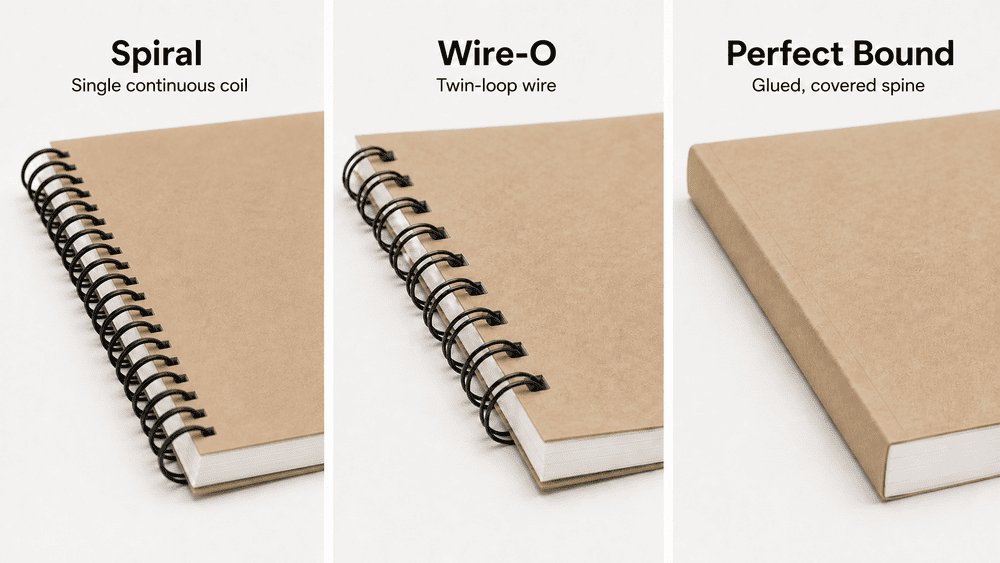
When comparing spiral vs Wire-O vs perfect bound notebooks, start with three different structures: a continuous coil, paired wire loops, and an adhesive-bound spine. Choose coil or Wire-O when fold-back use is important; consider conventional perfect binding when a smooth book-style spine matters more.
For brands, importers and wholesale buyers, the useful question is not which binding is universally best. It is which construction fits the intended writing experience, product design and production budget.
Spiral vs Wire-O vs Perfect Bound: Quick Comparison
This table describes typical exposed-coil, exposed-Wire-O and conventional softcover perfect-bound constructions. Special covers and lay-flat adhesive structures can change the result.
| Feature | Spiral / Continuous Coil | Wire-O / Twin-Loop Wire | Conventional Perfect Binding |
|---|---|---|---|
| How pages are held | One continuous coil passes through punched holes | Paired metal loops close around punched pages | Adhesive secures the prepared page edges at the spine |
| Opening behavior | Opens flat; pages can turn back through 360° | Opens flat; pages can fold back through 360° | Does not normally stay fully flat without assistance; not designed for fold-back use |
| Spine appearance | Visible helical coil | Visible, regularly spaced double loops | Smooth, covered book-style spine |
| Spine printing | No conventional printable spine panel | No conventional printable spine panel unless a separate cover structure provides one | Possible when the spine is wide enough for the artwork |
| Interior design concern | Punching clearance and writing space | Punching clearance and writing space | Inside gutter and comfortable access near the spine |
| Important sample checks | Coil ends, hole quality and page turning | Wire closure, loop shape and page turning | Page adhesion, cover attachment and opening behavior |
| Useful starting applications | Workbooks and practical everyday notebooks | Planners, meeting notebooks and coordinated stationery ranges | Softcover journals and book-style retail notebooks |
The opening characteristics are documented in GBC’s binding guide and PrintingCenterUSA’s perfect-binding explanation. Application choices still need to be tested against your own product brief.
What Is Spiral Binding?
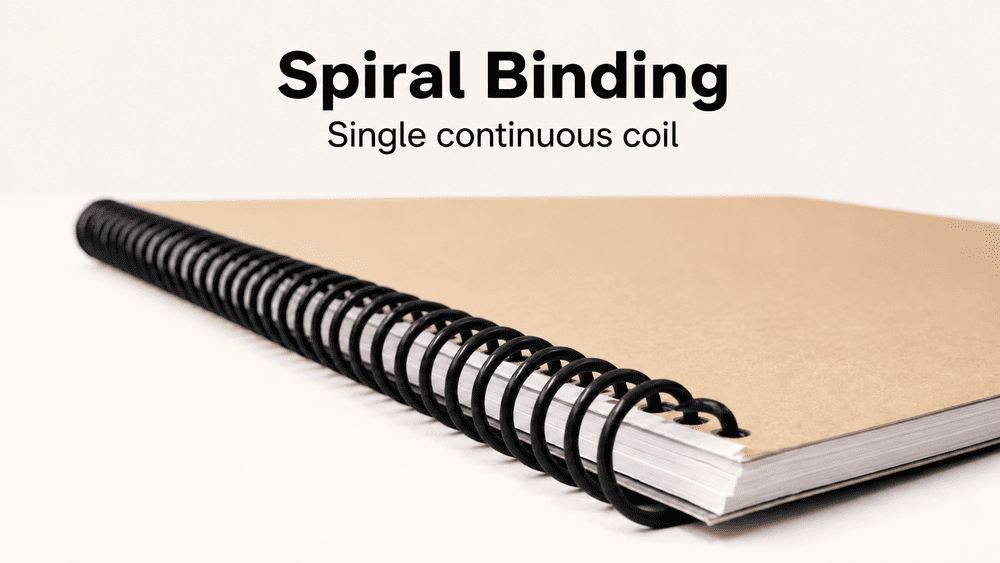
For this comparison, spiral binding means a single continuous coil, rather than double-loop wire.
The coil winds through holes along the binding edge. It can be plastic or metal: equipment and consumables manufacturer RENZ lists both plastic coils and metal spirals. Do not assume that every supplier means plastic when using the word “spiral.”
This construction is worth considering for a notebook that will be folded back during use. It lets the user work on one exposed page instead of keeping a full spread open.
For procurement, specify more than “spiral notebook.” Ask the supplier to identify:
- Coil material and finish.
- Coil diameter for the complete notebook.
- Hole pattern and binding edge.
- How the coil ends are secured.
- Compatibility with the proposed covers, dividers and pockets.
If a buyer likes the flexibility of a plastic-coil sample, substituting a metal spiral is a material change, even if both products are described as spiral-bound. Approve the actual construction you intend to order.
What Is Wire-O Binding?
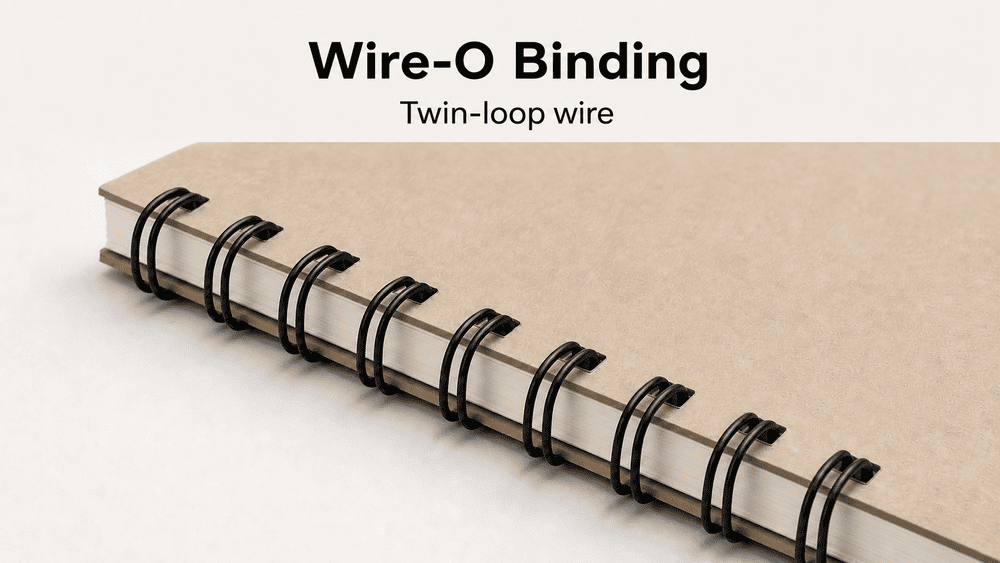
Wire-O uses a double-loop wire element, also commonly described as twin-loop or double-loop wire binding. The open element is positioned through the punched pages and closed around the book block.
James Burn, the originator of Wire-O, describes its double-loop binding system as allowing flat opening and back-to-back folding. Visually, the repeated pairs of loops distinguish it from a continuous spiral.
For a stationery collection, those exposed loops can become part of the design. Compare the wire finish against the cover artwork, foil details and accessories using a physical sample, not just separate color references.
Wire-O is a useful candidate for planners and meeting notebooks where opening convenience and a coordinated appearance both matter. That is a design choice, not proof that it is always stronger or more expensive than coil binding.
Why “Spiral” and “Wire-O” Can Be Confusing
Product categories do not always use technical terminology precisely. A supplier may group several exposed-ring constructions under “spiral notebooks.”
For example, YIMU’s Spiral Notebooks collection includes products described as Wire-O. Use the category to browse designs, then confirm the binding in the quotation.
A close-up photograph and a written description such as “continuous metal spiral” or “twin-loop wire” are more useful than the category name alone.
What Is Perfect Binding?
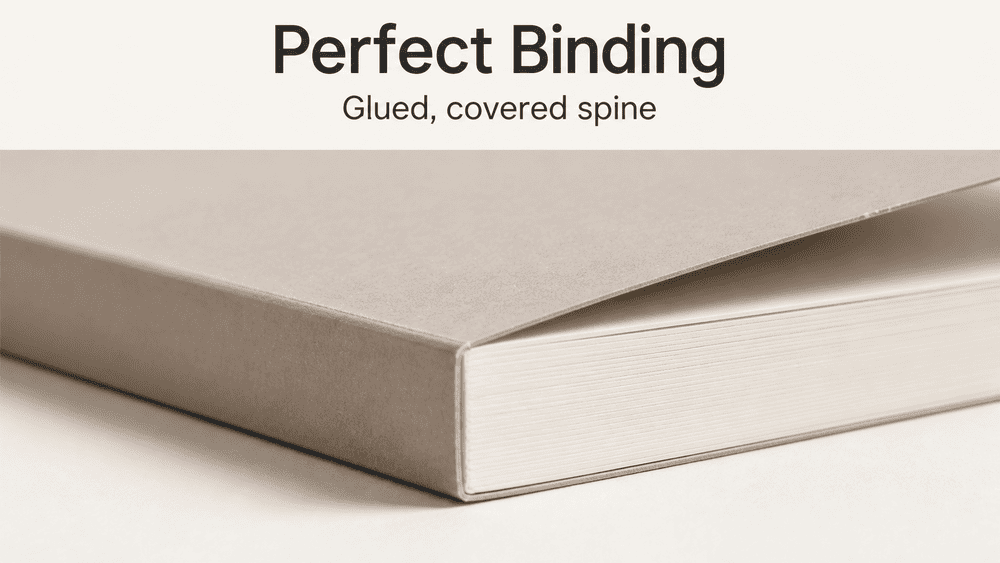
In conventional perfect binding, the gathered page block is prepared along the spine, bonded with adhesive, and attached to a wraparound softcover. The result has a covered spine rather than exposed loops.
That spine can provide space for a product name or collection identity, provided the finished thickness supports legible printing. Its width depends on the paper and page count, so the supplier should confirm it before the cover artwork is finalized.
Perfect binding is worth evaluating when you want a compact, book-style notebook. However, a smooth spine does not establish how comfortably the product will open.
Is Perfect Binding the Same as Any Glued Notebook?
No. “Adhesive-bound” is a broader description. A hardcover notebook can have an adhesive-bound book block, and some constructions combine sewing with adhesive.
Müller Martini’s perfect-binding equipment documentation distinguishes multiple book-block and cover configurations, including specialized lay-flat products. This illustrates why the finished structure matters more than a broad binding label.
When reviewing an adhesive-bound notebook collection, ask whether the proposed product has a conventional softcover perfect-bound structure, a glued hardcover book block, or another construction.
Five Details That Should Drive Your Decision
1. The Actual Writing Task
Start with a representative page from the intended notebook.
For a weekly planner, ask someone to fill in the fields closest to the binding. For a meeting notebook, have them write a full paragraph on both left- and right-hand pages. For a workbook, check whether instructions and response areas remain easy to use together.
Do not judge opening performance only at the middle of an empty sample. Test the front, middle and back, where the distribution of pages changes.
If users must write while standing or work at a small desk, include that situation in the review. Also invite left-handed users to try the sample when they are part of the intended audience.
2. Usable Page Space
The finished paper size is not the same as the comfortable writing area.
For coil and Wire-O, the layout needs room for holes and the user’s hand. For perfect binding, content near the inner gutter may be harder to reach or see. These requirements should be reflected in the artwork template.
Ask for the supplier’s binding-specific template before designing the complete interior. Do not transfer a layout from one binding to another without checking it at actual size.
For a two-page planner, avoid placing a critical word, number or task box across the center. Even a notebook that opens flat still has a physical separation between its pages.
See How to Customize Notebook Inner Pages for a broader approach to page planning and print-ready artwork.
3. Durability Under the Intended Handling
There is no defensible universal ranking of “spiral strongest, Wire-O second, perfect binding weakest.”
Different structures need different checks. An exposed wire can be distorted by pressure; GBC specifically cautions that wire-bound documents need protection during shipping. Adhesive-bound products instead require attention to the page-to-spine bond and cover attachment.
Translate “durable” into a review plan:
- Will the notebook be carried loose in a bag?
- Will it be opened and closed many times each day?
- Will users pull out pages?
- Will it travel individually by courier or in retail cartons?
- What damage would make it unacceptable for sale?
Agree sample tests and acceptance criteria with the supplier. A material label alone cannot answer these questions.
For glued products, ask which adhesive system and preparation method are proposed, and when the sample will be ready for assessment. Do not treat the words “PUR” or “EVA” as a complete quality specification or a guarantee of lay-flat performance.
4. Cover Design and Retail Presentation
Decide what the customer should notice first: the cover artwork, the exposed binding, or the book-style spine.
With an exposed binding, compare the loop color, cover edge and overall proportions together. A finish that looks attractive on a small swatch may dominate a compact notebook.
With a printed spine, approve the artwork on a bound sample. Confirm that text is centered and readable after production tolerances are considered, rather than simply fitting inside a digital rectangle.
Also evaluate the notebook in its intended display. A countertop stack, gift box and upright shelf each reveal different parts of the product.
5. Total Cost, Not Just Binding Price
The binding name does not determine the final unit price.
A fair comparison needs the same finished page size, paper specification, page count, printing, cover finish, accessories, order quantity and packaging requirements. Where the construction requires a difference, ask the supplier to identify it.
Request a breakdown of the main changes between options:
- Binding materials and production operations.
- Cover construction and artwork preparation.
- Dividers, pockets and other inserts.
- Sampling and setup charges, where applicable.
- Protective packaging, packed dimensions and carton quantities.
Then compare total order cost, including the agreed freight basis. Do not assume that a lower ex-factory price gives the lowest delivered cost.
If you split a collection into several bindings or designs, also confirm how quantities are allocated. Our custom notebook MOQ guide explains why the complete specification matters.
How Paper Thickness and Page Count Affect Binding
Tell the supplier both the page count and the paper specification.
For ordinary double-sided interior leaves, 160 pages means 80 leaves, excluding covers and any separately specified inserts. Writing “160 sheets” would describe a different quantity of paper.
Paper GSM measures mass per unit area, not thickness. Ask for the proposed paper’s caliper or a physical dummy when thickness is important.
For coil and Wire-O, the supplier needs to allow for the entire punched stack, including covers and inserts. A ring selected only for the interior pages may not suit the finished product.
For perfect binding, book-block thickness affects manufacturing feasibility and the cover’s spine panel. Do not use a universal minimum such as “all perfect-bound notebooks need 100 pages.” Equipment, paper and construction vary.
If the page count changes after sampling, recheck the binding and cover dimensions before approving production.
Which Binding Fits Your Notebook Project?
Use the following scenarios as starting points for sampling, not fixed rules.
A Workbook for Frequent Desk Use
Start by comparing coil and Wire-O samples if easy page turning and fold-back use are priorities. Test the real exercise layout, including any divider tabs, rather than choosing from a blank notebook alone.
If the workbook will be used heavily during travel, include the proposed packing and carrying conditions in the review.
A Branded Planner or Meeting Notebook
Wire-O is worth sampling when the paired-loop appearance suits the collection. Compare it with coil if the main priority is the writing experience and the exposed binding style is flexible.
Approve the product with its complete interior: dividers and pockets can change how it feels compared with a plain paper dummy.
A Book-Style Retail Journal
Consider conventional perfect binding when the design calls for a covered spine and a familiar softcover-book form.
If the customer experience depends on effortless flat opening, make that requirement explicit before choosing the construction. A different book-block or cover structure may be needed; do not assume the word “journal” guarantees it.
What to Include in a Binding Quote Request
A clear brief helps suppliers quote the same product:
- Use and audience: planner, journal, workbook, school notebook or another application.
- Size and orientation: finished interior dimensions and the edge to be bound.
- Binding: continuous coil, twin-loop wire, or the required adhesive-bound construction; attach a reference photo.
- Interior: pages and leaves, paper GSM, printing, layouts and inserts.
- Cover: material, thickness, finishes, artwork and any spine printing.
- Performance: opening behavior, fold-back requirement and handling expectations.
- Commercial details: quantity per design, packaging, destination and required delivery date.
If you want alternatives, ask for separately identified options. “Same notebook, cheaper binding” is not enough detail to control the changes.
Binding Sample Approval Checklist
Before approving bulk production, check the actual bound sample.
| Check | What to Confirm |
|---|---|
| Construction | Binding matches the written quotation and reference |
| Page turning | Pages turn without catching, binding or escaping |
| Opening | Front, middle and back behave as required for writing |
| Coil or wire finish | No exposed sharp ends, unacceptable gaps or distorted loops |
| Punched edge | Holes are clean and do not cut into important artwork |
| Glued spine | No loose leaves, visible splitting or unacceptable glue squeeze-out |
| Cover and spine | Alignment, attachment and any printed spine text are acceptable |
| Accessories | Pockets, tabs, ribbons and closures work with the finished construction |
| Packing | The agreed packing protects the binding and cover without excessive pressure |
Perform any destructive checks, such as page-pull testing, on designated test samples using an agreed method. Do not substitute an informal tug for a defined acceptance criterion.
Keep the approved sample linked to a specification version. For the wider approval process, use the Custom Notebook Sample Checklist.
Planning a Custom Notebook with YIMU
YIMU’s notebook range includes exposed-wire styles and adhesive-bound products. Our OEM & ODM notebook manufacturing services cover the wider product specification, including size, cover design, inner pages and branding.
Share a binding close-up together with your intended use. This helps distinguish a style reference from a production requirement and allows the proposed construction to be reviewed with the complete notebook design.
YIMU’s standard custom-order MOQ starts from 3,000 pieces, with the final requirement depending on the product specification and quantity allocation. Confirm the proposed materials, binding options and sample requirements in your project quotation.
Frequently Asked Questions
Are Spiral and Wire-O Notebooks the Same?
Not technically. In this guide, spiral means one continuous coil, while Wire-O means paired wire loops. A store or supplier may place both in a “spiral notebooks” category, so confirm the structure with a photograph and written specification.
Can Perfect Bound Notebooks Lie Flat?
Conventional perfect-bound notebooks should not be assumed to stay fully flat or fold back. Specialized adhesive-bound lay-flat constructions exist, but they must be specified and sampled separately.
Is Wire-O Always More Expensive Than Spiral Binding?
No. The result depends on binding material, dimensions, cover construction, production method and order quantity. Compare matched specifications and ask suppliers to identify any differences between their quotations.
Can Pages Be Removed or Replaced?
These are normally permanent bindings, not refill systems. Replacing pages may require removing and replacing the binding element or rebuilding the book.
If users need clean tear-out pages, specify and test perforation separately. If they need to rearrange pages regularly, discuss a refillable construction instead.
Can a Hardcover Notebook Use Wire-O?
Yes, a hard cover can be combined with twin-loop wire when the structure is designed for it. “Hardcover” describes the cover, not necessarily the method that holds the pages. Confirm cover thickness, punching and clearance in the sample.
Which Binding Is Best for a Private Label Notebook?
The best choice is the one that meets the intended use at the agreed cost and quality level. Start with the opening requirement, then compare appearance, interior layout, handling and packaging. Approve a complete sample before making claims about performance.
Choose the Binding Around the User
A continuous coil, twin-loop wire and an adhesive spine solve different design problems. The right choice becomes clearer when you test the actual pages, cover and packing together.
Send YIMU your reference notebook, finished size, paper, page count and quantity to discuss a suitable construction.